
Lameness continues to be one of the most significant and costly health challenges faced by dairy farmers in India. With the sector increasingly shifting toward high-yielding crossbred cattle—particularly those derived from indigenous breeds with exotic genetics such as Holstein Friesian and Jersey—the incidence of lameness is on the rise across both smallholder and commercial dairy systems.
A lame cow experiences pain with every step. This not only affects her mobility but also leads to reduced feed intake, lower milk production, delayed conception, loss of body condition, and increased veterinary costs. In many cases, affected animals are culled prematurely or suffer reduced longevity. Beyond animal welfare concerns, lameness has a direct and substantial economic impact on farm profitability. It also predisposes animals to secondary health complications, making it the third most critical issue in dairy farming—after mastitis and reproductive disorders.
Prevalence and Risk Factors in India
The prevalence of lameness in India varies widely depending on farm management, housing systems, and geographical conditions. Recent studies indicate that between 8% and 30% of crossbred dairy cows are affected nationwide.
A 2024 study conducted in Karnataka reported lameness prevalence of approximately 22% in large commercial farms, compared to around 5% in smallholder systems. This disparity is largely attributed to differences in housing conditions, including hard flooring, higher stocking densities, and limited preventive care in intensive operations.
In high-production states such as Punjab, front limb lesions account for nearly 29% of cases, while hind limb issues contribute to over 54%. A broader review of tropical Asian studies places the average prevalence at approximately 15%, though many farms report herd-level incidence of 20–25%, closely aligned with global averages of 22–23%.
Key risk factors include:
- Advancing age (particularly cows beyond 3–4 lactations)
- Poor body condition
- Hard or poorly designed flooring
- Wet and unhygienic housing conditions
- Lack of routine hoof trimming
Economic Impact
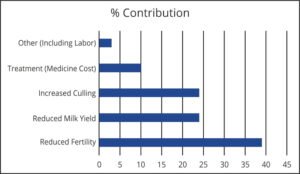 The financial implications of lameness extend well beyond treatment costs. Farmers face losses due to reduced milk yield, lower reproductive efficiency, increased labour, premature culling, and often the indiscriminate use of antibiotics.
Estimates from institutions such as Guru Angad Dev Veterinary and Animal Sciences University (GADVASU), along with government livestock reports (BAHS 2024) and veterinary studies, suggest annual losses of approximately INR 25,000–30,000 per affected cow. This represents a substantial and recurring economic burden for dairy operations.
Understanding the Causes
Lameness in dairy cattle broadly falls into two categories:
- Infectious Causes (~31%)
These include conditions such as digital dermatitis (Mortellaro disease), interdigital infections, and foot rot. Such issues are commonly associated with wet, unhygienic, and manure-laden environments.
- Non-Infectious Causes (~69%)
These include sole ulcers, white line disease, laminitis, and overgrown or imbalanced hooves. Prolonged standing on hard concrete surfaces is a major contributing factor, leading to hoof damage and uneven weight distribution.
- Nutritional and Management Factors
- High-concentrate diets leading to sub-acute ruminal acidosis (SARA)
- Abrupt dietary transitions, especially around calving
- Deficiencies in minerals essential for hoof strength
Hoof Structure and Its Importance
The bovine hoof is a robust, keratinised structure comparable to a natural protective boot. Each foot comprises two primary claws, supported by additional structures such as the hoof wall, sole, coronary band, and heel bulbs.
Most lameness originates within the hoof rather than the upper limb. Pain and discomfort trigger stress responses, disrupt hormonal balance, reduce feed intake, impair reproductive cycles, and ultimately lower milk yield. Even a small proportion of lame animals can significantly impact overall herd performance.
Prevention and Control Strategies
The encouraging aspect is that lameness can largely be prevented and managed through consistent and well-implemented practices:
- Regular Hoof Trimming
Routine professional hoof trimming is the most effective preventive measure. It ensures proper weight distribution, removes excess horn, and prevents lesion development. Techniques such as the Dutch five-step method are widely recommended. Ideally:
- Heifers should be assessed before first calving
- Lactating cows should be trimmed at least twice a year
- High-risk animals may require trimming every 3–4 months
- Skilled Workforce Development
The availability of trained hoof trimmers remains limited. Proper training or engagement of certified professionals is essential, as poor trimming practices can exacerbate problems. Larger farms may benefit from in-house expertise, while smaller farms can adopt cooperative models.
- Improved Housing and Flooring
Hard concrete surfaces should be modified with grooves or covered with rubber mats to improve traction. Providing soft bedding (sand or straw) encourages cows to rest adequately (12+ hours daily), reducing stress on hooves. Overcrowding should be avoided.
- Hygiene and Footbath Management
Maintaining clean, dry housing conditions is critical. Regular manure removal and the use of footbaths help control infectious agents. Structured hoof care programmes, when implemented in coordination with veterinarians and trained personnel, have demonstrated significant reductions in lameness incidence.
- Balanced Nutrition
Feeding strategies should aim to prevent ruminal acidosis, ensure gradual dietary transitions, and maintain optimal body condition. Adequate mineral supplementation supports hoof integrity.
- Early Detection and Monitoring
Routine observation of animal movement is essential. Mobility scoring systems can help identify early signs of lameness, allowing timely intervention and reducing severity.
- Holistic Management
Attention to transition cow management, adequate space allowance, and the specific needs of high-yielding crossbred animals can further reduce risk.
Conclusion
With the adoption of these measures—particularly regular hoof care, improved housing, and proactive monitoring—lameness prevalence can be reduced to below 5% in well-managed herds. The benefits are multifold: improved animal welfare, enhanced productivity, better reproductive performance, and significant cost savings.
In India’s rapidly evolving dairy sector, where intensification and crossbreeding are becoming the norm, investing in hoof health is no longer optional—it is essential.
Healthy hooves are the foundation of dairy productivity. Simply put: hooves carry the milk.
References are available upon request.