
 Dairy farming is a lifeline for millions of Indian families and a key pillar of agricultural growth. Yet, rising costs and low productivity continue to limit farmer profitability.
As India strives to double farmers’ income, we must ask: Are we truly increasing dairy farmers’ incomes, or merely sustaining their survival?
True progress begins when every dairy farmer earns more—not by owning more animals, but by unlocking greater value from each one.
This article examines the economic challenges facing dairy farmers by analysing the relationship between milk procurement prices and rising rearing costs. Feed and fodder account for 60–70% of milk production costs, while the prices of key feed ingredients have increased significantly without a proportional rise in milk prices, reducing farmers’ profitability. The article compares the revenue potential of cow and buffalo milk, highlights the importance of monitoring production costs and farm performance, and emphasises improving productivity per animal rather than herd size. It also outlines practical strategies to enhance profitability and ensure the long-term sustainability of dairy farming.
Daily Feed Requirements and Costs for Crossbred Cows
The daily feed requirements of a crossbred cow producing 10–12 litres of milk per day constitute the largest component of rearing costs. The major feed ingredients, their daily quantities, prevailing market prices (June 2026), and associated costs are presented in Table 1.
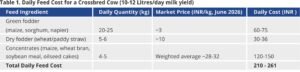 Concentrates account for the largest share of daily feed expenditure, contributing INR 120–150 per day because of their relatively high cost. Overall, the daily feed cost of maintaining a crossbred cow producing 10–12 litres of milk ranges from INR 210 to INR 261, making feed the single largest contributor to the total cost of milk production.
Annual Rearing Costs Per Cow
In addition to daily feed expenses, dairy farmer incur annual costs related to labor and other miscellaneous farm expenses. The estimated annual cost for maintaining a crossbred cow is presented in Table 2.
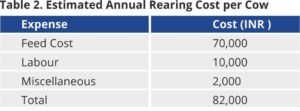 Feed accounts for the largest share of annual rearing cost, contributing INR 70,000, or nearly 85% of the total annual expenditure of INR 82,000. This underscores the importance of improving feed efficiency and adopting cost-effective feeding strategies to enhance dairy farm profitability.
Milk Procurement Prices: Cow vs. Buffalo
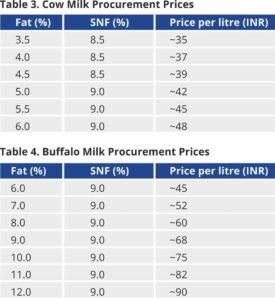
Milk procurement prices in India are primarily determined by the fat and solids-not-fat (SNF) content of milk. Since buffalo milk typically contains a higher fat percentage than cow milk, it generally commands a higher procurement price. Tables 3 and 4 present indicative procurement prices of cow and buffalo milk.
 Price Comparison
A comparison of the maximum procurement prices highlights the higher revenue potential of buffalo milk.
- Highest Cow Milk Price: ~INR 48 per litre (6.0% fat, 9.0% SNF)
- Highest Buffalo Milk Price: ~INR 90 per litre (12.0% fat, 9.0% SNF)
Although procurement prices are comparable at lower fat levels, buffalo milk commands significantly higher prices as fat content increases. At its highest procurement slab, buffalo milk fetches nearly 1.9 times the price of cow milk, offering substantially greater revenue potential for dairy farmers producing high-fat milk.
Economic Viability: Milk Revenue vs. Cost
To evaluate the economic viability of dairy farming, the estimated annual milk revenue from a crossbred cow was compared with its annual rearing cost.
Revenue Estimation
- Milk yield per lactation: 3,000 litres
- Average procurement price: INR 35 per litre (3.5% fat, 8.5% SNF)
- Total annual milk revenue: 3,000 litres × INR 35 = INR 105,000
Profitability Analysis
Comparing the annual milk revenue with the total annual rearing cost indicates that dairy farming can remain economically viable under the assumed production and pricing conditions.
- Total Milk Revenue: INR 105,000
- Total Annual Rearing Cost: INR 82,000
- Net Margin: INR 23,000 per cow per lactation
Based on these assumptions, a crossbred cow producing 3,000 litres of milk per lactation generates an estimated net margin of INR 23,000. However, this margin remains highly sensitive to fluctuations in feed prices, milk procurement prices, and animal productivity.
Key Findings
The economic analysis of dairy farming reveals that feed costs are the most dominant expense, both on a daily basis (INR 210-INR 261/day) and annually (INR 70,000 out of INR 82,000 total). While the daily costs for green and dry fodder are relatively low, concentrates contribute the most significantly to daily feed expenses. Furthermore, buffalo milk consistently yields higher procurement prices, especially at increased fat percentages, offering potentially greater revenue per litre compared to cow milk. Despite substantial rearing costs, the data indicates a positive net margin of INR 23,000 per cow per lactation cycle when producing 3,000 litres at a procurement price of INR 35/litre.
Way Ahead
To enhance profitability and sustainability in dairy farming, the following strategies are suggested:
Feed Cost Optimization: Given that feed is the largest expense, farmers should explore opportunities to optimize feed formulations and procurement. This could include cultivating more green fodder on-site, negotiating better prices for concentrates, or exploring alternative, cost-effective feed sources while maintaining nutritional standards. Farmers should adopt least-cost ration plans using locally available forage like Napier grass, paddy straw, and soybean cake, which can reduce feed costs by 19-22%. Growing your own green fodder instead of purchasing it can save INR 8,000 annually (27% reduction). Silage making and using drought-tolerant crops like sorghum and millet further lower costs in water-scarce regions.
Fair Milk Pricing: Milk procurement prices should reflect the increasing cost of production. Establishing a minimum procurement price linked to input costs would help protect dairy farmers from rising feed and labour expenses while ensuring sustainable farm incomes.
Enhancing Milk Quality: For both cow and buffalo farming, focusing on animal genetics and nutrition to improve milk fat and SNF percentages can directly lead to higher per-litre procurement prices, significantly boosting farmers’ income.
Strategic Breed Selection: Farmers might consider the higher revenue potential of buffalo milk due to its premium pricing at higher fat percentages. This could involve strategic investments in buffalo farming, especially in regions where demand for high-fat milk is strong.
Improving Productivity: Increasing milk yield per animal is more profitable than simply increasing herd size. The use of artificial insemination with genetically superior bulls, timely veterinary care, efficient reproductive management, and removing unproductive animals can substantially improve productivity and reduce per-litre production cost
Value Addition: Selling raw milk alone limits profitability. Processing milk into products such as ghee, paneer, curd, butter, and khoa generates higher returns, reduces wastage, and creates additional income streams. Even small-scale processing units can significantly improve farm profitability.
Efficient Farm Management: Improving labour efficiency, reducing avoidable expenses, maintaining accurate production records, and regularly monitoring production costs enable farmers to make informed management decisions and improve overall farm performance.
Conclusion
The future of dairy farming in India lies in producing more milk with fewer resources. Scientific feeding, genetic improvement, better animal health management, value addition, and sound financial planning are essential for overcoming rising input costs and improving farm profitability. Sustainable dairy farming is not about increasing herd size; it is about maximising productivity, minimising wastage, and increasing the economic return from every animal.
By Dr. Raja Mukherjee, Executive Vice President, Intas Pharmaceuticals Ltd.